A New Way to Learn Wine Through Cognitive Science
Wine is a complex system.
Behind every bottle lies a network of interconnected decisions: climate shapes ripening, soil influences vine vigor, viticulture defines balance, winemaking builds style, and the market determines viability. To truly understand wine, one must understand how all these variables interact.
However, most people do not learn wine this way.
Traditional learning tends to fragment knowledge. Regions, grape varieties, and techniques are studied separately. Characteristics, classifications, and processes are memorized. Yet rarely is the ability trained to integrate all of this into a coherent decision-making process.
The result is familiar: solid theoretical knowledge, but difficulty applying it in real-world situations.
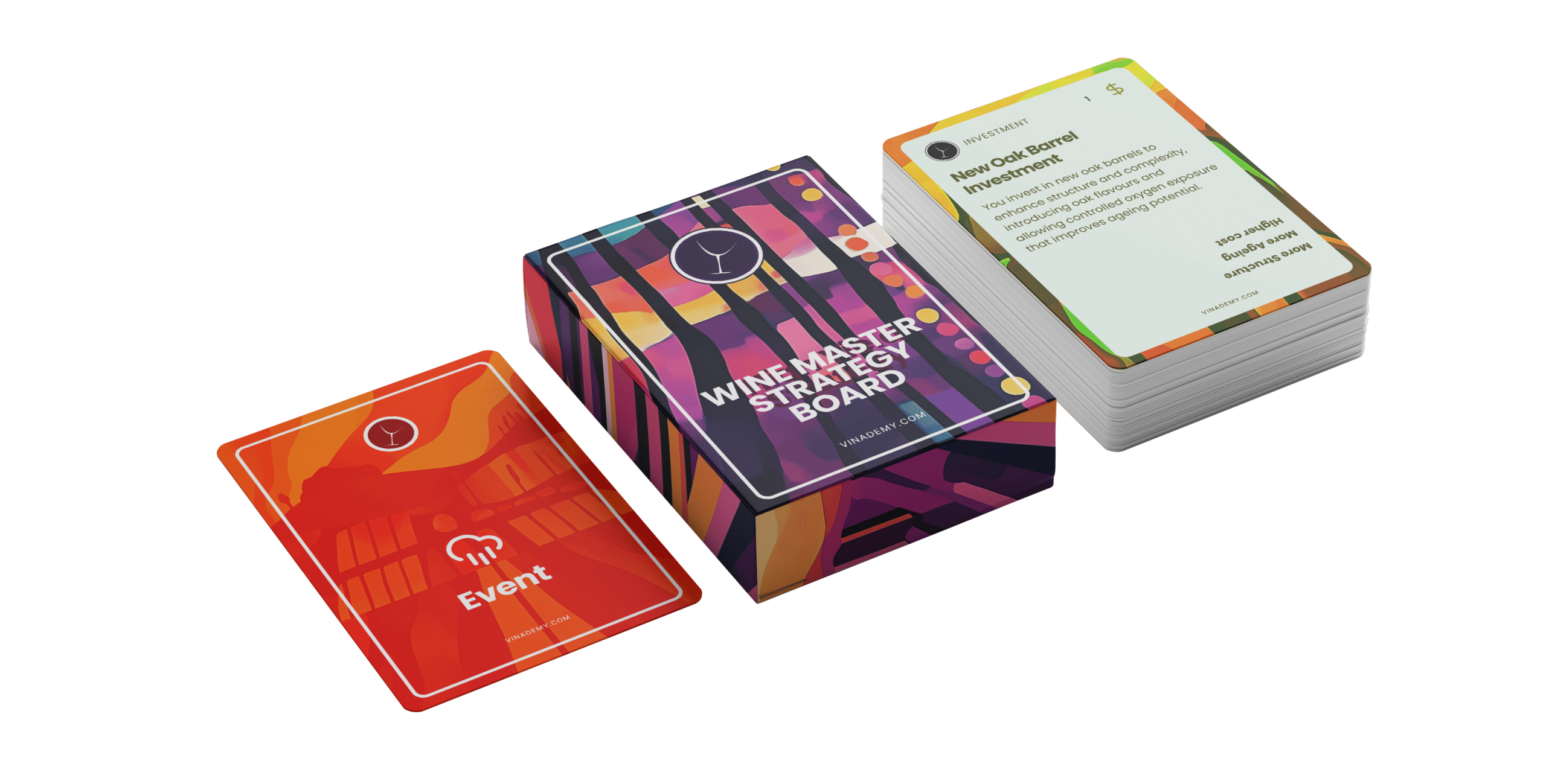
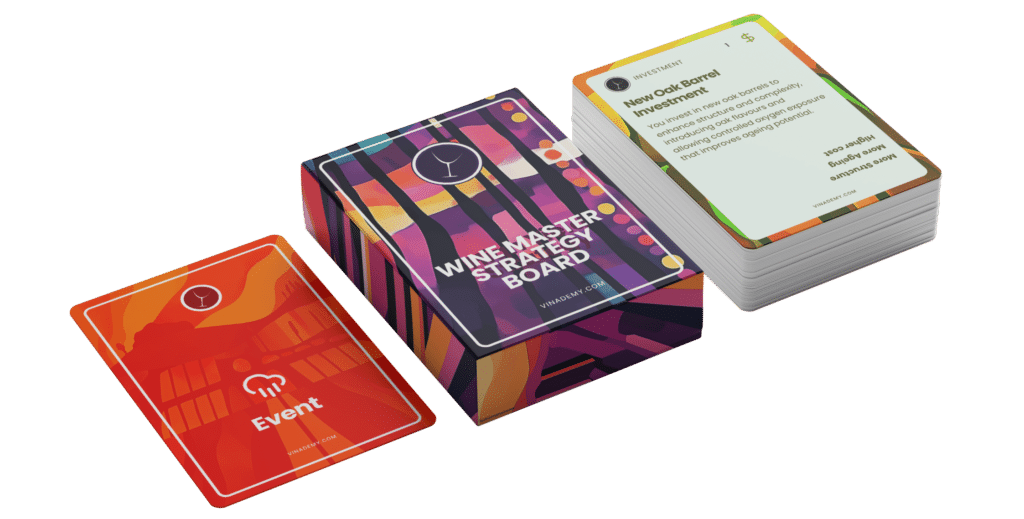
Wine Master Strategy was created precisely to close this gap — as a complete and innovative educational ecosystem based on systems thinking, developed by Luciano Wehrli (Wine Education Innovation Strategist – DipWSET).
Learning Wine Is Not About Memorizing, It’s About Deciding
The core premise behind Wine Master Strategy is simple, yet deeply transformative: wine is not understood by accumulating information, but by making decisions.
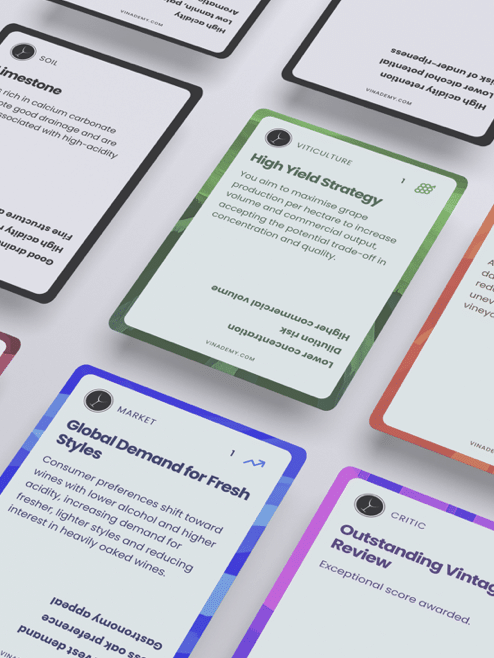
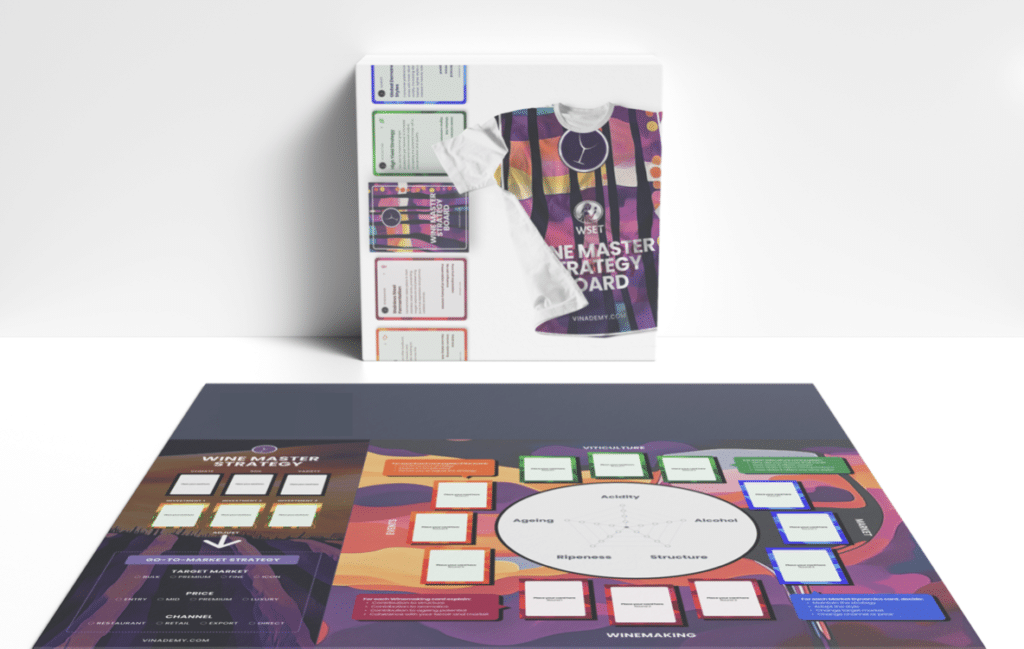
Instead of placing the learner in a passive role, the system puts them at the center of the process. Each participant takes on the role of a winery and must build a wine from scratch, facing the same constraints that exist in reality: a specific terroir, unexpected events, technical limitations, market pressure, and economic decisions.
Learning no longer happens by reading or listening, but by acting.
Each round of the game forces players to choose, justify, and adapt. There are no neutral decisions. Every action has consequences, and those consequences must be understood, anticipated, and defended.
Wine as a System
One of the most powerful aspects of this approach is that it naturally introduces systems thinking.
Wine is no longer a collection of isolated factors, but a system in which everything is connected. The player begins to understand that a decision made in the vineyard does not end there — it impacts the final style of the wine, its ageing potential, its market positioning, and ultimately its viability.
This way of thinking is fundamentally different from linear study. It is not about knowing what a cool climate is or what oak contributes, but about understanding when, why, and how to use each element.
That shift in perspective is what transforms learning.

The Importance of Style
At the core of the experience lies the concept of wine style.
Every decision made throughout the game affects five fundamental dimensions: acidity, alcohol, structure, aromatic intensity, and ageing potential.
These dimensions are not presented as abstract theory, but as variables that continuously evolve based on the player’s decisions.
Wine stops being something that simply “happens” and becomes something that is deliberately constructed.
Choosing an early harvest, reducing yields, using new oak, or avoiding malolactic fermentation is no longer a piece of information to memorize — it becomes a strategic tool to achieve a specific objective.
This approach leads to a key realization: there are no universally good or bad decisions. There are only decisions that are more or less coherent within a given context.
Learning Under Uncertainty
Another key element of the system is the introduction of uncertainty.
Throughout the game, players must deal with unexpected events: adverse weather conditions, production challenges, market shifts. These elements disrupt any rigid plan and force continuous adaptation.
This is essential from a learning perspective. In reality, decision-making rarely occurs in controlled environments. It happens under uncertainty, with incomplete information and constant pressure.
By integrating this dynamic, Wine Master Strategy trains a skill that goes far beyond wine: the ability to make decisions in complex environments.
The Strategic Dimension
Wine is not only a technical product — it is also a value proposition.
For this reason, the system incorporates a strategic layer in which players must define who their wine is for, through which channel it will be sold, and at what price point it will be positioned.
This dimension forces a connection between technical decisions and commercial reality, something that is often missing in traditional approaches.
Players begin to understand that a wine does not only need to be well made — it needs to make sense in the market. A fresh, high-acidity, low-alcohol wine may be technically excellent, but without the right positioning, it loses value.
This connection between product and market is one of the most valuable insights of the entire experience.
The Role of Reflection
While the board and cards structure the experience, real learning happens through reflection.
Every decision must be explained. Every choice must be justified. Every adjustment must be understood. This process is reinforced through the coherence matrix, where players record the logic behind their actions.
This activates key cognitive processes: retrieval, organization of knowledge, and consolidation of understanding. It is not just about doing, but about understanding what is being done.
The final defence phase takes this even further. Players must synthesize everything that happened during the game and build a coherent narrative. They must explain what they did, why they did it, and what result they achieved.
It is at this moment that learning truly consolidates.
A System Designed Through Cognitive Science
What makes this system effective is not only its subject matter, but its design.
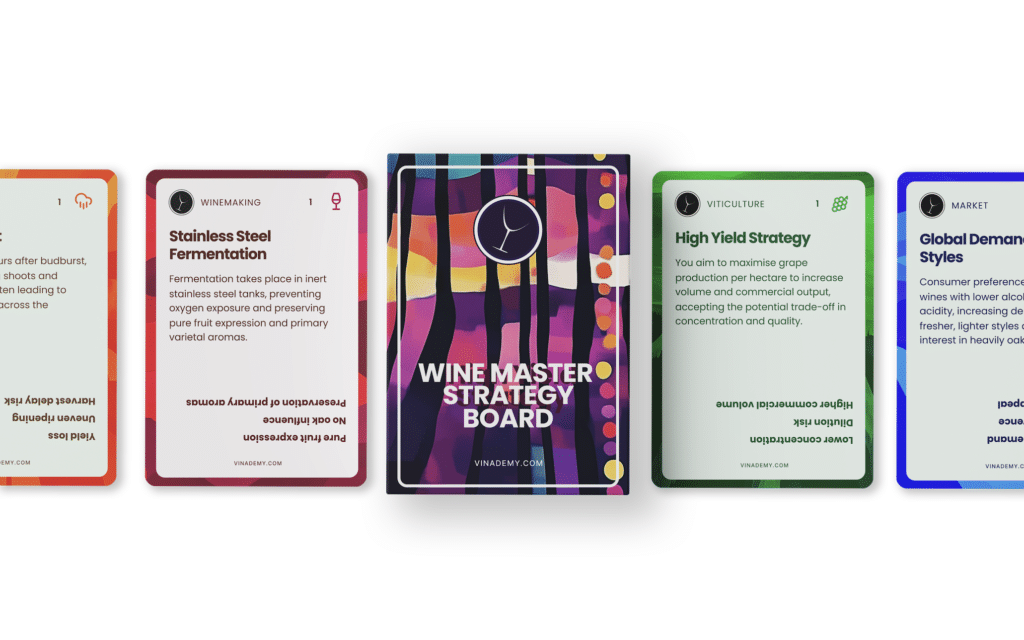
Wine Master Strategy integrates principles strongly supported by learning science: active learning, retrieval practice, continuous feedback, and experiential knowledge construction. These principles are not presented as theory — they are embedded in the gameplay itself.
The result is an experience that is not only more engaging, but significantly more effective.
Beyond Wine
Although the system is built around wine, its scope goes much further.
It represents a different way of learning — a multi-layered, innovative educational ecosystem. One that focuses on thinking, decision-making, and the ability to connect complex variables.
This approach can be applied to any field where complexity and uncertainty are part of the environment.
In the End
Wine is not learned only by studying. It is learned by making decisions, making mistakes, adjusting strategies, and understanding the consequences of each action.
Wine Master Strategy — and the broader educational ecosystem behind it — proposes exactly that: transforming learning into an active, structured, and deeply realistic experience.
It is not a game about wine. It is a way to learn how to think about wine.
In addition to Wine Master Strategy as the core experience, the system expands through a set of complementary assets and resources that enrich learning and make it deeper and more interconnected.
This ecosystem includes tools such as the coherence matrix, structured defence sheets, visual concept maps, mind maps, advanced thematic modules, study routines, and, progressively, digital solutions and intelligent AI-based assistants that enable practice, provide feedback, and reinforce reasoning.
Luciano Wehrli
Founder
Wine Education Innovation Strategist
AI for Wine Business Consultant
DipWSET – Weinakademiker
IG: @WehrliWines
